Psychologists explore behavior and mental processes, including
perception,
cognition,
attention,
emotion (
affect),
intelligence,
phenomenology,
motivation (
conation),
brain functioning, and
personality. This extends to interaction between people, such as
interpersonal relationships, including
psychological resilience,
family resilience, and other areas. Psychologists of diverse orientations also consider the
unconscious mind.
[3] Psychologists employ
empirical methods to infer
causal and
correlational relationships between psychosocial
variables. In
addition, or in
opposition, to employing
empirical and
deductive methods, some—especially
clinical and
counseling psychologists—at times rely upon
symbolic interpretation and other
inductive techniques. Psychology has been described as a "hub science",
[4] with psychological findings linking to research and perspectives from the social sciences,
natural sciences,
medicine,
humanities, and
philosophy.
While psychological knowledge is often applied to the
assessment and
treatment of
mental health problems, it is also directed towards understanding and solving problems in several spheres of
human activity. By many accounts psychology ultimately aims to benefit society.
[5][6] The majority of psychologists are involved in some kind of therapeutic role, practicing in clinical,
counseling, or
school settings. Many do scientific research on a wide range of topics related to mental processes and behavior, and typically work in university psychology departments or teach in other academic settings (e.g., medical schools, hospitals). Some are employed in
industrial and organizational settings, or in other areas
[7] such as
human development and aging,
sports,
health, and
the media, as well as in
forensic investigation and other aspects of
law.
Etymology and definitions
The word
psychology derives from Greek roots meaning study of the
psyche, or
soul (
ψυχή psukhē, "breath, spirit, soul" and -λογία
-logia, "study of" or "research").
[8] The
Latin word
psychologia was first used by the
Croatian humanist and
Latinist Marko Marulić in his book,
Psichiologia de ratione animae humanae in the late 15th century or early 16th century.
[9] The earliest known reference to the word
psychology in English was by
Steven Blankaart in 1694 in
The Physical Dictionary which refers to "Anatomy, which treats the Body, and Psychology, which treats of the Soul."
[10]
In 1890,
William James defined
psychology as "the science of mental life, both of its phenomena and their conditions". This definition enjoyed widespread currency for decades. However, this meaning was contested, notably by radical behaviorists such as
John B. Watson, who in his 1913 manifesto defined the discipline of psychology as the acquisition of information useful to the control of behavior. Also since James defined it, the term more strongly connotes techniques of scientific experimentation.
[11][12] Folk psychology refers to the understanding of ordinary people, as contrasted with that of psychology professionals.
[13]
History
In China, psychological understanding grew from the philosophical works of
Laozi and
Confucius, and later from the doctrines of Buddhism. This body of knowledge involves insights drawn from introspection and observation, as well as techniques for focused thinking and acting. It frames the universe as a division of, and interaction between, physical reality and mental reality, with an emphasis on purifying the mind in order to increase virtue and power. An ancient text known as
The Yellow Emperor's Classic of Internal Medicine identifies the brain as the nexus of wisdom and sensation, includes theories of personality based on
yin–yang balance, and analyzes mental disorder in terms of physiological and social disequilibria. Chinese scholarship focused on the brain advanced in the
Qing Dynasty with the work of Western-educated Fang Yizhi (1611–1671), Liu Zhi (1660–1730), and Wang Qingren (1768–1831). Wang Qingren emphasized the importance of the brain as the center of the nervous system, linked mental disorder with brain diseases, investigated the causes of dreams and insomnia, and advanced a theory of
hemispheric lateralization in brain function.
[17]
Distinctions in types of awareness appear in the ancient thought of India, influenced by
Hinduism. A central idea of the
Upanishads is the distinction between a person's transient mundane self and their
eternal unchanging soul. Divergent Hindu doctrines, and
Buddhism, have challenged this hierarchy of selves, but have all emphasized the importance of reaching higher awareness.
Yoga is a range of techniques used in pursuit of this goal. Much of the Sanskrit corpus was suppressed under the
British East India Company followed by the
British Raj in the 1800s. However, Indian doctrines influenced Western thinking via the
Theosophical Society, a New Age group which became popular among Euro-American intellectuals.
[18]
Psychology was a popular topic in
Enlightenment Europe. In Germany,
Gottfried Wilhelm Leibniz (1646–1716) applied his principles of calculus to the mind, arguing that mental activity took place on an indivisible continuum—most notably, that among an infinity of human perceptions and desires, the difference between conscious and unconscious awareness is only a matter of degree.
Christian Wolff identified psychology as its own science, writing
Psychologia empirica in 1732 and
Psychologia rationalis in 1734. This notion advanced further under
Immanuel Kant, who established the idea of
anthropology, with psychology as an important subdivision. However, Kant explicitly and notoriously rejected the idea of experimental psychology, writing that "the empirical doctrine of the soul can also never approach chemistry even as a systematic art of analysis or experimental doctrine, for in it the manifold of inner observation can be separated only by mere division in thought, and cannot then be held separate and recombined at will (but still less does another thinking subject suffer himself to be experimented upon to suit our purpose), and even observation by itself already changes and displaces the state of the observed object." Having consulted philosophers
Hegel and
Herbart, in 1825 the
Prussian state established psychology as a mandatory discipline in its rapidly expanding and highly influential
educational system. However, this discipline did not yet embrace experimentation.
[19] In England, early psychology involved
phrenology and the response to social problems including alcoholism, violence, and the country's well-populated mental asylums.
[20]
Beginning of experimental psychology

Wilhelm Wundt (seated) with colleagues in his psychological laboratory, the first of its kind.
Gustav Fechner began conducting
psychophysics research in
Leipzig in the 1830s, articulating
the principle that human perception of a stimulus varies logarithmically according to its intensity.
[21] Fechner's 1860
Elements of Psychophysics challenged Kant's stricture against quantitative study of the mind.
[19] In Heidelberg,
Hermann von Helmholtz conducted parallel research on sensory perception, and trained physiologist
Wilhelm Wundt. Wundt, in turn, came to Leipzig University, establishing the psychological
laboratory which brought
experimental psychology to the world. Wundt focused on breaking down mental processes into the most basic components, motivated in part by an analogy to recent advances in chemistry, and its successful investigation of the elements and structure of material.
[22] Paul Flechsig and
Emil Kraepelin soon created another influential psychology laboratory at Leipzig, this one focused on more on experimental
psychiatry.
[19]
Psychologists in Germany, Denmark, Austria, England, and the United States soon followed Wundt in setting up laboratories.
[23]G. Stanley Hall who studied with Wundt, formed a psychology lab at
Johns Hopkins University in Maryland, which became internationally influential. Hall, in turn, trained Yujiro Motora, who brought experimental psychology, emphasizing psychophysics, to the
Imperial University of Tokyo.
[24] Wundt assistant
Hugo Münsterberg taught psychology at Harvard to students such as
Narendra Nath Sen Gupta—who, in 1905, founded a psychology department and laboratory at the
University of Calcutta.
[18] Wundt students
Walter Dill Scott,
Lightner Witmer, and
James McKeen Cattell worked on developing tests for mental ability. Catell, who also studied with eugenicist
Francis Galton, went on to found the
Psychological Corporation. Wittmer focused on mental testing of children; Scott, on selection of employees.
[25]
Another student of Wundt,
Edward Titchener, created the psychology program at
Cornell University and advanced a doctrine of
"structuralist" psychology. Structuralism sought to analyze and classify different aspects of the mind, primarily through the method of
introspection.
[26] William James,
John Dewey and
Harvey Carr advanced a more expansive doctrine called
functionalism, attuned more to human–environment actions. In 1890 James wrote an influential book,
The Principles of Psychology, which expanded on the realm of structuralism, memorably described the human "
stream of consciousness", and interested many American students in the emerging discipline.
[26][27][28] Dewey integrated psychology with social issues, most notably by promoting the cause
progressive education to assimilate immigrants and inculcate moral values in children.
[29]
A different strain of experimentalism, with more connection to physiology, emerged in South America, under the leadership of Horacio G. Piñero at the
University of Buenos Aires.
[30] Russia, too, placed greater emphasis on the biological basis for psychology, beginning with
Ivan Sechenov's 1873 essay, "Who Is to Develop Psychology and How?" Sechenov advanced the idea of brain
reflexes and aggressively promoted a
deterministic viewpoint on human behavior.
[31]
Consolidation and funding
One of the earliest psychology societies was
La Société de Psychologie Physiologique in France, which lasted 1885–1893. The first meeting of the
International Congress of Psychology took place in Paris, in August 1889, amidst
the World's Fair celebrating the centennial of the French Revolution. William James was one of three Americans among the four hundred attendees. The
American Psychological Association was founded soon after, in 1892. The International Congress continued to be held, at different locations in Europe, with wider international participation. The Sixth Congress, Geneva 1909, included presentations in Russian, Chinese, and Japanese, as well as
Esperanto. After a hiatus for World War I, the Seventh Congress met in Oxford, with substantially greater participation from the war-victorious Anglo-Americans. In 1929, the Congress took place at Yale University in New Haven, Connecticut, attended by hundreds of members of the American Psychological Association
[23]Tokyo Imperial University led the way in bringing the new psychology to the East, and from Japan these ideas diffused into China.
[17][24]
American psychology gained status during World War I, during which a standing committee headed by
Robert Yerkes administered mental tests ("
Army Alpha" and "
Army Beta") to almost 1.8 million GIs.
[34] Subsequent
funding for behavioral research came in large part from the
Rockefeller family, via the
Social Science Research Council.
[35][36]Rockefeller charities funded the National Committee on Mental Hygiene, which promoted the concept of mental illness and lobbied for psychological supervision of child development.
[34][37] Through the Bureau of Social Hygiene and later funding of
Alfred Kinsey, Rockefeller foundations established
sex research as a viable discipline in the U.S.
[38]Under the influence of the Carnegie-funded
Eugenics Record Office, the Draper-funded
Pioneer Fund, and other institutions, the
eugenics movement also had a significant impact on American psychology; in the 1910s and 1920s, eugenics became a standard topic in psychology classes.
[39]
During World War II and the Cold War, the U.S. military and intelligence agencies established themselves as leading funders of psychology—through the armed forces and in the new
Office of Strategic Services intelligence agency. University of Michigan psychologist Dorwin Cartwright reported that university researchers began large-scale propaganda research in 1939–1941, and "the last few months of the war saw a social psychologist become chiefly responsible for determining the week-by-week-propaganda policy for the United States Government." Cartwright also wrote that psychologists had significant roles in managing the domestic economy.
[40] The Army rolled out its new
General Classification Test and engaged in massive studies of troop morale. In the 1950s, the
Rockefeller Foundation and
Ford Foundation collaborated with the
Central Intelligence Agency to fund research on psychological warfare.
[41] In 1965, public controversy called attention to the Army's
Project Camelot—the "Manhattan Project" of social science—an effort which enlisted psychologists and anthropologists to analyze foreign countries for strategic purposes.
[42][43]
In Germany after
World War I, psychology held institutional power through the military, and subsequently expanded along with the rest of the military under the
Third Reich.
[19]Under the direction of
Hermann Göring's cousin
Matthias Göring, the
Berlin Psychoanalytic Institute was renamed the Göring Institute. Freudian psychoanalysts were expelled and persecuted under the anti-Jewish policies of the Nazi Party, and all psychologists had to distance themselves from Freud and Adler.
[44] The Göring Institute was well-financed throughout the war with a mandate to create a "New German Psychotherapy". This psychotherapy aimed to align suitable Germans with the overall goals of the Reich; as described by one physician: "Despite the importance of analysis, spiritual guidance and the active cooperation of the patient represent the best way to overcome individual mental problems and to subordinate them to the requirements of the
Volk and the
Gemeinschaft." Psychologists were to provide
Seelenführung, leadership of the mind, to integrate people into the new vision of a German community.
[45] Harald Schultz-Hencke melded psychology with the Nazi theory of biology and racial origins, criticizing psychoanalysis as a study of the weak and deformed.
[46] Johannes Heinrich Schultz, a German psychologist recognized for developing the technique of
autogenic training, prominently advocated sterilization and euthanasia of men considered genetically undesirable, and devised techniques for facilitating this process.
[47] After the war, some new institutions were created and some psychologists were discredited due to Nazi affiliation.
Alexander Mitscherlich founded a prominent applied psychoanalysis journal called
Psyche and with funding from the Rockefeller Foundation established the first clinical psychosomatic medicine division at Heidelberg University. In 1970, psychology was integrated into the required studies of medical students.
[48]
After the Russian Revolution, psychology was heavily promoted by the
Bolsheviks as a way to engineer the "New Man" of socialism. Thus, university psychology departments trained large numbers of students, for whom positions were made available at schools, workplaces, cultural institutions, and in the military. An especial focus was
pedology, the study of child development, regarding which
Lev Vygotsky became a prominent writer.
[31] The Bolsheviks also promoted
free love and embranced the doctrine of
psychoanalysis as an antidote to sexual repression.
[49] Although pedology and intelligence testing fell out of favor in 1936, psychology maintained its privileged position as an instrument of the Soviet state.
[31] Stalinist purges took a heavy toll and instilled a climate of fear in the profession, as elsewhere in Soviet society.
[50] Following World War II, Jewish psychologists past and present (including Vygotsky,
A. R. Luria, and Aron Zalkind) were denounced; Ivan Pavlov (posthumously) and Stalin himself were aggrandized as heroes of Soviet psychology.
[51] Soviet academics was speedily liberalized during the
Khrushchev Thaw, and cybernetics, linguistics, genetics, and other topics became acceptable again. There emerged a new field called "engineering psychology" which studied mental aspects of complex jobs (such as pilot and cosmonaut). Interdisciplinary studies became popular and scholars such as
Georgy Shchedrovitsky developed systems theory approaches to human behavior.
[52]
Twentieth-century Chinese psychology originally modeled the United States, with translations from American authors like William James, the establishment of university psychology departments and journals, and the establishment of groups including the Chinese Association of Psychological Testing (1930) and the Chinese Psychological Society (1937). Chinese psychologists were encouraged to focus on education and language learning, with the aspiration that education would enable modernization and nationalization. John Dewey, who lectured to Chinese audiences in 1918–1920, had a significant influence on this doctrine. Chancellor
T'sai Yuan-p'ei introduced him at
Peking University as a greater thinker than Confucius.
Kuo Zing-yang who received a PhD at the University of California, Berkeley, became President of
Zhejiang University and popularized behaviorism.
[53] After the
Chinese Communist Party gained control of the country, the Stalinist USSR became the leading influence, with Marxism–Leninism the leading social doctrine and Pavlovian conditioning the approved concept of behavior change. Chinese psychologists elaborated on Lenin's model of a "reflective" consciousness, envisioning an "active consciousness" (
tzu-chueh neng-tung-li) able to transcend material conditions through hard work and ideological struggle. They developed a concept of "recognition" (
jen-shih) which referred the interface between individual perceptions and the socially accepted worldview. (Failure to correspond with party doctrine was "incorrect recognition".)
[54]Psychology education was centralized under the Chinese Academy of Sciences, supervised by the State Council. In 1951 the Academy created a Psychology Research Office, which in 1956 became the Institute of Psychology. Most leading psychologists were educated in the United States, and the first concern of the Academy was re-education of these psychologists in the Soviet doctrines. Child psychology and pedagogy for nationally cohesive education remained a central goal of the discipline.
[55]
Disciplinary organization
Institutions
In 1920,
Édouard Claparède and
Pierre Bovet created a new
applied psychology organization called the International Congress of Psychotechnics Applied to Vocational Guidance, later called the International Congress of Psychotechnics and then the
International Association of Applied Psychology.
[23] The IAAP is considered the oldest international psychology association.
[56] Today, at least 65 international groups deal with specialized aspects of psychology.
[56] In response to male predominance in the field, female psychologists in the U.S. formed National Council of Women Psychologists in 1941. This organization became the International Council of Women Psychologists after World War II, and the International Council of Psychologists in 1959. Several associations including the
Association of Black Psychologists and the Asian American Psychological Association have arisen to promote non-European racial groups in the profession.
[56]
The world federation of national psychological societies is the
International Union of Psychological Science (IUPsyS), founded in 1951 under the auspices of
UNESCO, the United Nations cultural and scientific authority.
[23][57] Psychology departments have since proliferated around the world, based primarily on the Euro-American model.
[18][57] Since 1966, the Union has published the
International Journal of Psychology.
[23] IAAP and IUPsyS agreed in 1976 each to hold a congress every four years, on a staggered basis.
[56]
The Interamerican Society of Psychology, founded in 1951, aspires to promote psychology and coordinate psychologists across the Western Hemisphere. It holds the Interamerican Congress of Psychology and had 1000 members in year 2000. The European Federation of Professional Psychology Associations, founded in 1981, represents 30 national associations with a total of 100,000 individual members. At least 30 other international groups organize psychologists in different regions.
[56]
In some places, governments legally regulate who can provide psychological services or represent themselves as a "psychologist".
[58] The American Psychological Association defines a psychologist as someone with a doctoral degree in psychology.
[59]
Boundaries
Early practitioners of experimental psychology distinguished themselves from
parapsychology, which in the late nineteenth century enjoyed great popularity (including the interest of scholars such as William James), and indeed constituted the bulk of what people called "psychology". Parapsychology,
hypnotism, and
psychism were major topics of the early International Congresses. But students of these fields were eventually ostractized, and more or less banished from the Congress in 1900–1905.
[23] Parapsychology persisted for a time at Imperial University, with publications such as
Clairvoyance and Thoughtography by Tomokichi Fukurai, but here too it was mostly shunned by 1913.
[24]
As a discipline, psychology has long sought to fend off accusations that it is a "soft" science. Philosopher of science
Thomas Kuhn's 1962 critique implied psychology overall was in a pre-paradigm state, lacking the agreement on overarching theory found in mature sciences such as
chemistry and
physics.
[60] Because some areas of psychology rely on research methods such as surveys and
questionnaires, critics asserted that psychology is not an objective science. Skeptics have suggested that
personality,
thinking, and
emotion, cannot be directly measured and are often inferred from subjective self-reports, which may be problematic. Experimental psychologists have devised a variety of ways to indirectly measure these elusive phenomenological entities.
[61][62][63]
Divisions still exist within the field, with some psychologists more oriented towards the unique experiences of individual humans, which cannot be understood only as data points within a larger population. Critics inside and outside the field have argued that mainstream psychology has become increasingly dominated by a "cult of empiricism" which limits the scope of its study by using only methods derived from the physical sciences.
[64] Feminist critiques along these lines have argued that claims to scientific objectivity obscure the values and agenda of (historically mostly male)
[34] researchers. Jean Grimshaw, for example, argues that mainstream psychological research has advanced a
patriarchal agenda through its efforts to control behavior.
[65]
Major schools of thought
Biological

MRI depicting the human brain. The arrow indicates the position of the
hypothalamus.
Psychologists generally consider the organism the basis of the mind, and therefore a vitally related area of study.
Psychiatrists and neuropsychologists work at the interface of mind and body.
[66] Biological psychology, also known as physiological psychology,
[67] or neuropsychology is the study of the biological substrates of behavior and mental processes. Key research topics in this field include
comparative psychology, which studies humans in relation to other animals, and
perception which involves the physical mechanics of sensation as well as neural and mental processing.
[68] For centuries, a leading question in biological psychology has been whether and how mental functions might be
localized in the brain. From
Phineas Gage to
H. M. and
Clive Wearing,
individual people with mental issues traceable to physical damage have inspired new discoveries in this area.
[67] Modern neuropsychology could be said to originate in the 1870s, when in France
Paul Broca traced production of speech to the left frontal gyrus, thereby also demonstrating hemispheric lateralization of brain function. Soon after,
Carl Wernicke identified a related area necessary for the understanding of speech.
[69]
The contemporary field of
behavioral neuroscience focuses on physical causes underpinning behavior. For example,
physiological psychologists use animal models, typically rats, to study the neural, genetic, and cellular mechanisms that underlie specific behaviors such as learning and memory and fear responses.
[70] Cognitive neuroscientists investigate the neural correlates of psychological processes in humans using neural imaging tools, and
neuropsychologists conduct psychological assessments to determine, for instance, specific aspects and extent of cognitive deficit caused by brain damage or disease. The
biopsychosocial model is an integrated perspective toward understanding consciousness, behavior, and social interaction. It assumes that any given behavior or mental process affects and is affected by dynamically interrelated biological, psychological, and social factors.
[71]
Evolutionary psychology examines cognition and personality traits from an
evolutionary perspective. This perspective suggests that
psychological adaptations evolved to solve recurrent problems in human ancestral environments. Evolutionary psychology offers complementary explanations for the mostly proximate or developmental explanations developed by other areas of psychology: that is, it focuses mostly on ultimate or "why?" questions, rather than proximate or "how?" questions. "How?" questions are more directly tackled by
behavioral genetics research, which aims to understand how
genes and environment impact behavior.
[72]
The search for biological origins of psychological phenomena has long involved debates about the importance of
race, and especially the relationship between
race and intelligence. The idea of
white supremacy and indeed the modern concept of race itself arose during the process of world conquest by Europeans.
[73] Carl von Linnaeus's four-fold classification of humans classifies Europeans as intelligent and severe, Americans as contented and free, Asians as ritualistic, and Africans as lazy and capricious. Race was also used to justify the construction of socially specific mental disorders such as
drapetomania and
dysaesthesia aethiopica—the behavior of uncooperative African slaves.
[74]After the creation of experimental psychology, "ethnical psychology" emerged as a subdiscipline, based on the assumption that studying primitive races would provide an important link between animal behavior and the psychology of more evolved humans.
[75]
Behavioral
Psychologists take
human behavior as a main area of study. Much of the research in this area began with tests on mammals, based on the idea that humans exhibit similar fundamental tendencies. Behavioral research ever aspires to improve the effectiveness of techniques for
behavior modification.
Early behavioral researchers studied stimulus–response pairings, now known as
classical conditioning. They demonstrated that behaviors could be linked through repeated association with
stimuli eliciting
pain or
pleasure.
Ivan Pavlov—known best for inducing dogs to salivate in the presence of a stimulus previous linked with food—became a leading figure in the Soviet Union and inspired followers to use his methods on humans.
[31] In the United States,
Edward Lee Thorndike initiated "
connectionism" studies by trapping animals in "puzzle boxes" and rewarding them for escaping. Thorndike wrote in 1911: "There can be no moral warrant for studying man's nature unless the study will enable us to control his acts."
[76] From 1910–1913 the American Psychological Association went through a sea change of opinion, away from
mentalism and towards "behavioralism", and in 1913
John B. Watson coined the term
behaviorism for this school of thought.
[77] Watson's famous
Little Albert experiment in 1920 demonstrated that repeated use of upsetting loud noises could instill
phobias (aversions to other stimuli) in an infant human.
[12][78] Karl Lashley, a close collaborator with Watson, examined biological manifestations of learning in the brain.
[67]
Embraced and extended by
Clark L. Hull,
Edwin Guthrie, and others, behaviorism became a widely used research paradigm.
[26] A new method of "instrumental" or "
operant" conditioning added the concepts of
reinforcement and
punishment to the model of behavior change.
Radical behaviorists avoided discussing the inner workings of the mind, especially the unconscious mind, which they considered impossible to assess scientifically.
[79] Operant conditioning was first described by Miller and Kanorski and popularized in the U.S. by
B. F. Skinner, who emerged as a leading intellectual of the behaviorist movement.
[80][81]
Noam Chomsky delivered an influential critique of radical behaviorism on the grounds that it could not adequately explain the complex mental process of
language acquisition.
[82][83][84] Martin Seligman and colleagues discovered that the conditioning of dogs led to outcomes ("
learned helplessness") that opposed the predictions of behaviorism.
[85][86] Skinner's behaviorism did not die, perhaps in part because it generated successful practical applications.
[82] Edward C. Tolman advanced a hybrid "cognitive behaviorial" model, most notably with his 1948 publication discussing the
cognitive maps used by rats to guess at the location of food at the end of a modified maze.
[87]
The
Association for Behavior Analysis International was founded in 1974 and by 2003 had members from 42 countries. The field has been especially influential in Latin America, where it has a regional organization known as ALAMOC:
La Asociación Latinoamericana de Análisis y Modificación del Comportamiento. Behaviorism also gained a strong foothold in Japan, where it gave rise to the Japanese Society of Animal Psychology (1933), the Japanese Association of Special Education (1963), the Japanese Society of Biofeedback Research (1973), the Japanese Association for Behavior Therapy (1976), the Japanese Association for Behavior Analysis (1979), and the Japanese Association for Behavioral Science Research (1994).
[88] Today the field of behaviorism is also commonly referred to as
behavior modification or
behavior analysis.
[88]
Cognitive
Green Red Blue
Purple Blue Purple
Blue Purple Red
Green Purple Green
The Stroop effect refers to the fact that naming the color of the first set of words is easier and quicker than the second.
Cognitive psychology studies
cognition, the
mental processes underlying mental activity.
Perception,
attention,
reasoning,
thinking,
problem solving,
memory,
learning,
language, and
emotion are areas of research. Classical cognitive psychology is associated with a school of thought known as
cognitivism, whose adherents argue for an
information processing model of mental function, informed by
functionalism and
experimental psychology.
Starting in the 1950s, the experimental techniques developed by Wundt, James, Ebbinghaus, and others re-emerged as experimental psychology became increasingly cognitivist—concerned with
information and its
processing—and, eventually, constituted a part of the wider
cognitive science.
[89] Some called this development the
cognitive revolution because it rejected the anti-mentalist dogma of behaviorism as well as the strictures of psychoanalysis.
[89]

The
Müller–Lyer illusion. Psychologists make inferences about mental processes from shared phenomena such as optical illusions.
Technological advances also renewed interest in mental states and representations. English neuroscientist
Charles Sherrington and Canadian psychologist
Donald O. Hebb used experimental methods to link psychological phenomena with the structure and function of the brain. The rise of
computer science,
cybernetics and
artificial intelligence suggested the value of comparatively studying information processing in humans and machines. Research in cognition had proven practical since
World War II, when it aided in the understanding of weapons operation.
[91]
A popular and representative topic in this area is
cognitive bias, or irrational thought. Psychologists (and economists) have classified and described a
sizeable catalogue of biases which recur frequently in human thought. The
availability heuristic, for example, is the tendency to overestimate the importance of something which happens to come readily to mind.
Elements of behaviorism and cognitive psychology were synthesized to form
cognitive behavioral therapy, a form of psychotherapy modified from techniques developed by American psychologist
Albert Ellis and American psychiatrist
Aaron T. Beck. Cognitive psychology was subsumed along with other disciplines, such as
philosophy of mind, computer science, and neuroscience, under the cover discipline of cognitive science.
Social
Social psychology is the study of how humans think about each other and how they relate to each other. Social psychologists study such topics as the influence of others on an individual's behavior (e.g.
conformity,
persuasion), and the formation of beliefs,
attitudes, and
stereotypes about other people.
Social cognition fuses elements of social and cognitive psychology in order to understand how people process, remember, or distort social information. The study of
group dynamics reveals information about the nature and potential optimization of leadership, communication, and other phenomena that emerge at least at the
microsocial level. In recent years, many social psychologists have become increasingly interested in
implicit measures,
mediational models, and the interaction of both person and social variables in accounting for behavior. The study of human society is therefore a potentially valuable source of information about the causes of psychiatric disorder. Some sociological concepts applied to psychiatric disorders are the
social role,
sick role,
social class, life event,
culture,
migration,
social, and
total institution.
Psychoanalysis
Psychoanalysis comprises a method of investigating the mind and interpreting experience; a systematized set of theories about human behavior; and a form of psychotherapy to treat psychological or emotional distress, especially conflict originating in the
unconscious mind.
[92] This school of thought originated in the 1890s with Austrian medical doctors including
Josef Breuer (physician),
Alfred Adler (physician),
Otto Rank (psychoanalyst), and most prominently
Sigmund Freud (neurologist). Freud's psychoanalytic theory was largely based on interpretive methods,
introspection and clinical observations. It became very well known, largely because it tackled subjects such as
sexuality,
repression, and the unconscious. These subjects were largely taboo at the time, and Freud provided a catalyst for their open discussion in polite society.
[49] Clinically, Freud helped to pioneer the method of
free association and a therapeutic interest in
dream interpretation.
[93][94]
Swiss psychiatrist
Carl Jung, influenced by Freud, elaborated a theory of the
collective unconscious—a primordial force present in all humans, featuring
archetypes which exerted a profound influence on the mind. Jung's competing vision formed the basis for
analytical psychology, which later led to the
archetypal and
process-oriented schools. Other well-known psychoanalytic scholars of the mid-20th century include
Erik Erikson,
Melanie Klein,
D. W. Winnicott,
Karen Horney,
Erich Fromm,
John Bowlby, and Sigmund Freud's daughter,
Anna Freud. Throughout the 20th century, psychoanalysis evolved into diverse schools of thought which could be called
Neo-Freudian. Among these schools are
ego psychology,
object relations, and
interpersonal,
Lacanian, and
relational psychoanalysis.
Psychologists such as
Hans Eysenck and philosophers including
Karl Popper criticized psychoanalysis. Popper argued that psychoanalysis had been misrepresented as a scientific discipline,
[95] whereas Eysenck said that psychoanalytic tenets had been contradicted by
experimental data. By the end of 20th century, psychology departments in
American universities mostly marginalized Freudian theory, dismissing it as a "desiccated and dead" historical artifact.
[96] However, researchers in the emerging field of
neuro-psychoanalysis today defend some of Freud's ideas on scientific grounds,
[97] while scholars of the
humanities maintain that Freud was not a "scientist at all, but ... an
interpreter".
[96]
Existential-humanistic theories
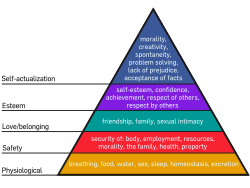
Psychologist Abraham Maslow in 1943 posited that humans have a hierarchy of needs, and it makes sense to fulfill the basic needs first (food, water etc.) before higher-order needs can be met.
[98]
Humanistic psychology developed in the 1950s as a movement within academic psychology, in reaction to both behaviorism and psychoanalysis.
[99] The humanistic approach sought to glimpse the whole person, not just fragmented parts of the personality or isolated cognitions.
[100] Humanism focused on uniquely human issues, such as
free will, personal growth,
self-actualization,
self-identity,
death,
aloneness,
freedom, and
meaning. It emphasized subjective meaning, rejection of determinism, and concern for positive growth rather than pathology.
[citation needed] Some founders of the humanistic school of thought were American psychologists
Abraham Maslow, who formulated a
hierarchy of human needs, and
Carl Rogers, who created and developed
client-centered therapy. Later,
positive psychology opened up humanistic themes to scientific modes of exploration.
The American Association for Humanistic Psychology, formed in 1963, declared:
Humanistic psychology is primarily an orientation toward the whole of psychology rather than a distinct area or school. It stands for respect for the worth of persons, respect for differences of approach, open-mindedness as to acceptable methods, and interest in exploration of new aspects of human behavior. As a "third force" in contemporary psychology, it is concerned with topics having little place in existing theories and systems: e.g., love, creativity, self, growth, organism, basic need-gratification, self-actualization, higher values, being, becoming, spontaneity, play, humor, affection, naturalness, warmth, ego-transcendence, objectivity, autonomy, responsibility, meaning, fair-play, transcendental experience, peak experience, courage, and related concepts.
[101]
In the 1950s and 1960s, influenced by philosophers
Søren Kierkegaard and
Martin Heidegger and, psychoanalytically trained American psychologist
Rollo May pioneered an
existential branch of psychology, which included
existential psychotherapy: a method based on the belief that inner conflict within a person is due to that individual's confrontation with the givens of existence. Swiss psychoanalyst
Ludwig Binswanger and American psychologist
George Kelly may also be said to belong to the existential school.
[102] Existential psychologists differed from more "humanistic" psychologists in their relatively neutral view of
human nature and their relatively positive assessment of anxiety.
[103] Existential psychologists emphasized the humanistic themes of death, free will, and meaning, suggesting that meaning can be shaped by
myths, or narrative patterns,
[104] and that it can be encouraged by an acceptance of the free will requisite to an
authentic, albeit often anxious, regard for death and other future prospects.
Themes
Personality
Personality psychology is concerned with enduring patterns of behavior, thought, and emotion—commonly referred to as
personality—in individuals. Theories of personality vary across different psychological schools and orientations. They carry different assumptions about such issues as the role of the unconscious and the importance of childhood experience. According to Freud, personality is based on the dynamic interactions of the
id, ego, and super-ego.
[107] In order to develop a taxonomy of personality constructs,
trait theorists, in contrast, attempt to describe the personality sphere in terms of a discrete number of key traits using the statistical data-reduction method of
factor analysis. Although the number of proposed traits has varied widely, an early biologically-based model proposed by
Hans Eysenck, the 3rd mostly highly cited psychologist of the 20th Century (after Freud, and Piaget respectively), suggested that at least three major trait constructs are necessary to describe human personality structure:
extraversion–introversion,
neuroticism-stability, and
psychoticism-normality.
Raymond Cattell, the 7th most highly cited psychologist of the 20th Century (based on the scientific peer-reviewed journal literature)
[108] empirically derived a theory of
16 personality factors at the primary-factor level, and up to 8 broader second-stratum factors (at the Eysenckian level of analysis), rather than the "Big Five" dimensions.
[109][110][111][112] Dimensional models of personality are receiving increasing support, and a version of dimensional assessment has been included in the
DSM-V. However, despite a plethora of research into the various versions of the "Big Five" personality dimensions, it appears necessary to move on from static conceptualizations of personality structure to a more dynamic orientation, whereby it is acknowledged that personality constructs are subject to learning and change across the lifespan.
[113][114]
Unconscious mind
Study of the
unconscious mind, a part of the psyche outside the awareness of the individual which nevertheless influenced thoughts and behavior was a hallmark of early psychology. In one of the first psychology experiments conducted in the United States,
C. S. Peirce and
Joseph Jastrow found in 1884 that subjects could choose the minutely heavier of two weights even if consciously uncertain of the difference.
[118] Freud popularized this concept, with terms like
Freudian slip entering popular culture, to mean an uncensored intrusion of unconscious thought into one's speech and action. His 1901 text
The Psychopathology of Everyday Life catalogues hundreds of everyday events which Freud explains in terms of unconscious influence.
Pierre Janet advanced the idea of a
subconscious mind, which could contain autonomous mental elements unavailable to the scrutiny of the subject.
[119]
Behaviorism notwithstanding, the unconscious mind has maintained its importance in psychology. Cognitive psychologists have used a "filter" model of
attention, according to which much information processing takes place below the threshold of consciousness, and only certain processes, limited by nature and by simultaneous quantity, make their way through the filter. Copious research has shown that subconscious
priming of certain ideas can covertly influence thoughts and behavior.
[119] A significant hurdle in this research is proving that a subject's conscious mind has not grasped a certain stimulus, due to the unreliability of self-reporting. For this reason, some psychologists prefer to distinguish between
implicit and
explicit memory. In another approach, one can also describe a
subliminal stimulus as meeting an
objective but not a
subjective threshold.
[120]
Motivation
Psychologists such as William James initially used the term
motivation to refer to intention, in a sense similar to the concept of
will in European philosophy. With the steady rise of Darwinian and Freudian thinking,
instinct also came to be seen as a primary source of motivation.
[125] According to
drive theory, the forces of instinct combine into a single source of energy which exerts a constant influence. Psychoanalysis, like biology, regarded these forces as physical demands made by the organism on the nervous system. However, they believed that these forces, especially the sexual instincts, could become entangled and transmuted within the psyche. Classical psychoanalysis conceives of a struggle between the
pleasure principle and the
reality principle, roughly corresponding to id and ego. Later, in
Beyond the Pleasure Principle, Freud introduced the concept of the
death drive, a compulsion towards aggression, destruction, and
psychic repetition of traumatic events.
[126] Meanwhile, behaviorist researchers used simple dichotomous models (pleasure/pain, reward/punishment) and well-established principles such as the idea that a thirsty creature will take pleasure in drinking.
[125][127] Clark Hull formalized the latter idea with his
drive reduction model.
[128]
Hunger, thirst, fear, sexual desire, and thermoregulation all seem to constitute fundamental motivations for animals.
[127] Humans also seem to exhibit a more complex set of motivations—though theoretically these could be explained as resulting from primordial instincts—including desires for belonging, self-image, self-consistency, truth, love, and control.
[129][130]
Motivation can be modulated or manipulated in many different ways. Researchers have found that
eating, for example, depends not only on the organism's fundamental need for
homeostasis—an important factor causing the experience of
hunger—but also on circadian rhythms, food availability, food palatability, and cost.
[127] Abstract motivations are also malleable, as evidenced by such phenomena as
goal contagion: the adoption of goals, sometimes unconsciously, based on inferences about the goals of others.
[131] Vohs and
Baumeister suggest that contrary to the need-desire-fulfilment cycle of animal instincts, human motivations sometimes obey a "getting begets wanting" rule: the more you get a reward such as self-esteem, love, drugs, or money, the more you want it. They suggest that this principle can even apply to food, drink, sex, and sleep.
[132]
Development

Developmental psychologists would engage a child with a book and then make observations based on how the child interacts with the object.
Mainly focusing on the development of the human mind through the life span,
developmental psychology seeks to understand how people come to perceive, understand, and act within the world and how these processes change as they age. This may focus on cognitive, affective,
moral, social, or neural development. Researchers who study children use a number of unique research methods to make observations in natural settings or to engage them in experimental tasks. Such tasks often resemble specially designed games and activities that are both enjoyable for the child and scientifically useful, and researchers have even devised clever methods to study the mental processes of infants. In addition to studying children, developmental psychologists also study
aging and processes throughout the life span, especially at other times of rapid change (such as
adolescence and
old age). Developmental psychologists draw on the full range of psychological theories to inform their research.
Genes and environment
All researched psychological traits are influenced by both
genes and environment, to varying degrees.
[133][134] These two sources of influence are often confounded in observational research of individuals or families. An example is the transmission of
depression from a depressed mother to her offspring. Theory may hold that the offspring, by virtue of having a depressed mother in his or her (the offspring's) environment, is at risk for developing depression. However, risk for depression is also influenced to some extent by
genes. The mother may both carry genes that contribute to her depression but will also have passed those genes on to her offspring thus increasing the offspring's risk for depression. Genes and environment in this simple transmission model are completely
confounded. Experimental and
quasi-experimental behavioral genetic research uses
genetic methodologies to disentangle this
confound and understand the nature and origins of
individual differences in behavior.
[72] Traditionally this research has been conducted using
twin studies and
adoption studies, two designs where genetic and environmental influences can be partially un-confounded. More recently, the availability of
microarray molecular genetic or
genome sequencing technologies allows researchers to measure participant
DNA variation directly, and test whether individual genetic variants within
genes are associated with psychological traits and
psychopathology through methods including
genome-wide association studies. One goal of such research is similar to that in
positional cloning and its success in
Huntington's: once a causal gene is discovered biological research can be conducted to understand how that gene influences the phenotype. One major result of genetic association studies is the general finding that psychological traits and psychopathology, as well as complex medical diseases, are highly
polygenic,
[135][136][137][138][139] where a large number (on the order of hundreds to thousands) of genetic variants, each of small effect, contribute to individual differences in the behavioral trait or propensity to the disorder. Active research continues to understand the genetic and environmental bases of behavior and their interaction.
Applications
Psychology encompasses many subfields and includes different approaches to the study of mental processes and behavior:
Mental testing
Psychological testing has ancient origins, such as
examinations for the Chinese civil service dating back to 2200 BC. Written exams began during the Han dynasty (202 BC.–AD. 200). By 1370, the Chinese system required a stratified series of tests, involving essay writing and knowledge of diverse topics. The system was ended in 1906.
[140] In Europe, mental assessment took a more physiological approach, with theories of
physiognomy—judgment of character based on the face—described by Aristotle in 4th century BC Greece. Physiognomy remained current through the Enlightenment, and added the doctrine of
phrenology: a study of mind and intelligence based on simple assessment of neuroanatomy.
[141]
When experimental psychology came to Britain,
Francis Galton was a leading practitioner, and, with his procedures for measuring reaction time and sensation, is considered an inventor of modern mental testing (also known as
psychometrics).
[142] James McKeen Cattell, a student of Wundt and Galton, brought the concept to the United States, and in fact coined the term "mental test".
[143] In 1901, Cattell's student
Clark Wissler published discouraging results, suggesting that mental testing of Columbia and Barnard students failed to predict their academic performance.
[143] In response to 1904 orders from the
Minister of Public Instruction, French psychologists
Alfred Binet and
Théodore Simon elaborated a new test of intelligence in 1905–1911, using a range of questions diverse in their nature and difficulty. Binet and Simon introduced the concept of
mental age and referred to the lowest scorers on their test as
idiots.
Henry H. Goddard put the Binet-Simon scale to work and introduced classifications of mental level such as
imbecile and
feebleminded. In 1916 (after Binet's death), Stanford professor
Lewis M. Terman modified the Binet-Simon scale (renamed the
Stanford–Binet scale) and introduced the
intelligence quotient as a score report.
[144] From this test, Terman concluded that mental retardation "represents the level of intelligence which is very, very common among Spanish-Indians and Mexican families of the Southwest and also among negroes. Their dullness seems to be racial."
[145]
Following the
Army Alpha and
Army Beta tests for soldiers in World War I, mental testing became popular in the US, where it was soon applied to school children. The federally created National Intelligence Test was administered to 7 million children in the 1920s, and in 1926 the
College Entrance Examination Board created the
Scholastic Aptitude Test to standardize college admissions.
[146] The results of intelligence tests were used to argue for segregated schools and economic functions—i.e. the preferential training of
Black Americans for manual labor. These practices were criticized by black intellectuals such a
Horace Mann Bond and
Allison Davis.
[145] Eugenicists used mental testing to justify and organize
compulsory sterilization of individuals classified as
mentally retarded.
[39] In the United States, tens of thousands of men and women were sterilized. Setting a precedent which has never been overturned, the U.S. Supreme Court affirmed the constitutionality of this practice in the 1907 case
Buck v. Bell.
[147]
Today mental testing is a routine phenomenon for people of all ages in Western societies.
[148] Modern testing aspires to criteria including standardization of procedure,
consistency of results, output of an interpretable score, statistical norms describing population outcomes, and, ideally,
effective prediction of behavior and life outcomes outside of testing situations.
[149]
Mental health care
The provision of psychological health services is generally called
clinical psychology in the U.S. The definitions of this term are various and may include
school psychology and
counseling psychology. Practitioners typically includes people who have graduated from doctoral programs in clinical psychology but may also include others. In Canada, the above groups usually fall within the larger category of
professional psychology. In Canada and the US, practitioners get bachelor's degrees and doctorates, then spend one year in an internship and one year in postdoctoral education. In Mexico and most other Latin American and European countries, psychologists do not get bachelor's and doctorate degrees; instead, they take a three-year professional course following high school.
[59] Clinical psychology is at present the largest specialization within psychology.
[150] It includes the study and application of psychology for the purpose of understanding, preventing, and relieving psychologically based distress, dysfunction or
mental illness and to promote subjective
well-being and personal development. Central to its practice are psychological assessment and psychotherapy although clinical psychologists may also engage in research, teaching, consultation, forensic testimony, and program development and administration.
[151]
Credit for the first psychology clinic in the United States typically goes to
Lightner Witmer, who established his practice in Philadelphia in 1896. Another modern psychotherapist was
Morton Prince.
[150] For the most part, in the first part of the twentieth century, most mental health care in the United States was performed by specialized medical doctors called psychiatrists. Psychology entered the field with its refinements of mental testing, which promised to improve diagnosis of mental problems. For their part, some psychiatrists became interested in using psychoanalysis and other forms of
psychodynamic psychotherapy to understand and treat the mentally ill.
[34] In this type of treatment, a specially trained therapist develops a close relationship with the patient, who discusses wishes, dreams, social relationships, and other aspects of mental life. The therapist seeks to uncover repressed material and to understand why the patient creates defenses against certain thoughts and feelings. An important aspect of the therapeutic relationship is
transference, in which deep unconscious feelings in a patient reorient themselves and become manifest in relation to the therapist.
[152]
Psychiatric psychotherapy blurred the distinction between psychiatry and psychology, and this trend continued with the rise of
community mental health facilities and
behavioral therapy, a thoroughly non-psychodynamic model which used behaviorist learning theory to change the actions of patients. A key aspect of behavior therapy is empirical evaluation of the treatment's effectiveness. In the 1970s,
cognitive-behavior therapy arose, using similar methods and now including the cognitive constructs which had gained popularity in theoretical psychology. A key practice in behavioral and cognitive-behavioral therapy is exposing patients to things they fear, based on the premise that their responses (fear, panic, anxiety) can be deconditioned.
[153]
Mental health care today involves psychologists and
social workers in increasing numbers. In 1977, National Institute of Mental Health director
Bertram Brown described this shift as a source of "intense competition and role confusion".
[34] Graduate programs issuing doctorates in psychology (PsyD) emerged in the 1950s and underwent rapid increase through the 1980s. This degree is intended to train practitioners who might conduct scientific research.
[59]
The work performed by clinical psychologists tends to be influenced by various therapeutic approaches, all of which involve a formal relationship between professional and client (usually an individual, couple, family, or small group). Typically, these approaches encourage new ways of thinking, feeling, or behaving. Four major theoretical perspectives are
psychodynamic,
cognitive behavioral,
existential–humanistic, and systems or
family therapy. There has been a growing movement to integrate the various therapeutic approaches, especially with an increased understanding of issues regarding culture, gender, spirituality, and sexual orientation. With the advent of more robust research findings regarding psychotherapy, there is evidence that most of the major therapies have equal effectiveness, with the key common element being a strong
therapeutic alliance.
[155][156]Because of this, more training programs and psychologists are now adopting an
eclectic therapeutic orientation.
[157][158][159][160][161]
Diagnosis in clinical psychology usually follows the
Diagnostic and Statistical Manual of Mental Disorders (DSM), a handbook first published by the American Psychiatric Association in 1952. New editions over time have increased in size and focused more on medical language.
[162] The study of mental illnesses is called
abnormal psychology.
Education

An example of an item from a cognitive abilities test used in educational psychology.
Educational psychology is the study of how humans learn in
educational settings, the effectiveness of educational interventions, the psychology of teaching, and the
social psychology of
schools as organizations. The work of child psychologists such as
Lev Vygotsky,
Jean Piaget, and
Jerome Bruner has been influential in creating
teaching methods and educational practices. Educational psychology is often included in teacher education programs in places such as North America, Australia, and New Zealand.
School psychology combines principles from
educational psychology and
clinical psychology to understand and treat students with learning disabilities; to foster the intellectual growth of
gifted students; to facilitate
prosocial behaviors in adolescents; and otherwise to promote safe, supportive, and effective learning environments. School psychologists are trained in educational and behavioral assessment, intervention, prevention, and consultation, and many have extensive training in research.
[163]
Work
Industrialists soon brought the nascent field of psychology to bear on the study of
scientific management techniques for improving workplace efficiency. This field was at first called
economic psychology or
business psychology; later,
industrial psychology,
employment psychology, or
psychotechnology.
[164] An important early study examined workers at Western Electric's Hawthorne plant in Cicero, Illinois from 1924–1932. With funding from the Laura Spelman Rockefeller Fund and guidance from Australian psychologist
Elton Mayo, Western Electric experimented on thousands of factory workers to assess their responses to illumination, breaks, food, and wages. The researchers came to focus on workers' responses to observation itself, and the term
Hawthorne effect is now used to describe the fact that people work harder when they think they're being watched.
[165]
The name
industrial and organizational psychology (I–O) arose in the 1960s and became enshrined as the
Society for Industrial and Organizational Psychology, Division 14 of the American Psychological Association, in 1973.
[164] The goal is to optimize human potential in the workplace. Personnel psychology, a subfield of I–O psychology, applies the methods and principles of psychology in selecting and evaluating workers. I–O psychology's other subfield,
organizational psychology, examines the effects of work environments and management styles on worker motivation,
job satisfaction, and productivity.
[166] The majority of I–O psychologists work outside of academia, for private and public organizations and as consultants.
[164] A psychology consultant working in business today might expect to provide executives with information and ideas about their industry, their target markets, and the organization of their company.
[167]
Military and intelligence
One role for psychologists in the military is to evaluate and counsel soldiers and other personnel. In the U.S., this function began during World War I, when
Robert Yerkes established the School of Military Psychology at
Fort Oglethorpe in Georgia, to provide psychological training for military staff military.
[34][168] Today, U.S Army psychology includes psychological screening, clinical psychotherapy,
suicide prevention, and treatment for post-traumatic stress, as well as other aspects of health and workplace psychology such as
smoking cessation.
[169]
Psychologists may also work on a diverse set of campaigns known broadly as
psychological warfare. Psychologically warfare chiefly involves the use of
propaganda to influence enemy soldiers and civilians. In the case of so-called
black propaganda the propaganda is designed to seem like it originates from a different source.
[170] The
CIA's
MKULTRA program involved more individualized efforts at
mind control, involving techniques such as hypnosis, torture, and covert involuntary administration of
LSD.
[171] The U.S. military used the name
Psychological Operations (PSYOP) until 2010, when these were reclassified as Military Information Support Operations (MISO), part of
Information Operations (IO).
[172] Psychologists are sometimes involved in assisting the interrogation and torture of suspects, though this has sometimes been denied by those involved and sometimes opposed by others.
[173]
Health, well-being, and social change
Medical facilities increasingly employ psychologists to perform various roles. A prominent aspect of
health psychology is the
psychoeducation of patients: instructing them in how to follow a medical regimen. Health psychologists can also educate doctors and conduct research on patient
compliance.
[174]
Psychologists in the field of
public health use a wide variety of interventions to influence human behavior. These range from public relations campaigns and outreach to governmental laws and policies. Psychologists study the composite influence of all these different tools in an effort to influence whole
populations of people.
[175]
Positive psychology is the study of factors which contribute to human
happiness and well-being, focusing more on people who are currently health. In 2010
Clinical Psychological Review published a special issue devoted to positive psychological interventions, such as
gratitude journaling and the physical expression of
gratitude. Positive psychological interventions have been limited in scope, but their effects are thought to be superior to that of
placebos, especially with regard to helping people with
body image problems.
Research methods
Controlled experiments
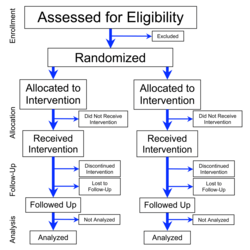
Flowchart of four phases (enrollment, intervention allocation, follow-up, and data analysis) of a parallel randomized trial of two groups, modified from the
CONSORT 2010 Statement[178]

The experimenter (E) orders the teacher (T), the subject of the experiment, to give what the latter believes are painful electric shocks to a learner (L), who is actually an actor and
confederate. The subject believes that for each wrong answer, the learner was receiving actual electric shocks, though in reality there were no such punishments. Being separated from the subject, the confederate set up a tape recorder integrated with the electro-shock generator, which played pre-recorded sounds for each shock level etc.
[179]
A
true experiment with
random allocation of subjects to conditions allows researchers to make strong inferences about causal relationships. In an experiment, the researcher alters parameters of influence, called
independent variables, and measures resulting changes of interest, called
dependent variables. Prototypical experimental research is conducted in a laboratory with a carefully controlled environment.
Repeated-measures experiments are those which take place through intervention on multiple occasions. In research on the effectiveness of
psychotherapy, experimenters often compare a given treatment with
placebo treatments, or compare different treatments against each other. Treatment type is the independent variable. The dependent variables are outcomes, ideally assessed in several ways by different professionals.
[180] Using
crossover design, researchers can further increase the strength of their results by testing both of two treatments on two groups of subjects.
Quasi-experimental design refers especially to situations precluding random assignment to different conditions. Researchers can use common sense to consider how much the nonrandom assignment threatens the study's
validity.
[181] For example, in research on the best way to affect reading achievement in the first three grades of school, school administrators may not permit educational psychologists to randomly assign children to phonics and whole language classrooms, in which case the psychologists must work with preexisting classroom assignments. Psychologists will compare the achievement of children attending phonics and whole language classes.
Other forms of statistical inference
Statistical surveys are used in psychology for measuring attitudes and traits, monitoring changes in mood, checking the validity of experimental manipulations, and for other psychological topics. Most commonly, psychologists use paper-and-pencil surveys. However, surveys are also conducted over the phone or through e-mail. Web-based surveys are increasingly used to conveniently reach many subjects.
Observational studies analyze uncontrolled data in search of correlations;
multivariate statistics are typically used to interpret the more complex situation.
Cross-sectional observational studies use data from a single point in time, whereas
longitudinal studies are used to study trends across the life span. Longitudinal studies track the same people, and therefore detect more individual, rather than cultural, differences. However, they suffer from lack of controls and from confounding factors such as
selective attrition (the bias introduced when a certain type of subject disproportionately leaves a study).
Technological assays
A classic and popular tool used to relate mental and neural activity is the
electroencephalogram (EEG), a technique using amplified electrodes on a person's scalp to measure voltage changes in different parts of the brain.
Hans Berger, the first researcher to use EEG on an unopened skull, quickly found that brains exhibit signature "
brain waves": electric oscillations which correspond to different states of consciousness. Researchers subsequently refined statistical methods for synthesizing the electrode data, and identified unique brain wave patterns such as the
delta wave observed during non-REM sleep.
[186]
Newer
functional neuroimaging techniques include
functional magnetic resonance imaging and
positron emission tomography, both of which track the flow of blood through the brain. These technologies provide more localized information about activity in the brain and create representations of the brain with widespread appeal. They also provide insight which avoids the classic problems of subjective self-reporting. It remains challenging to draw hard conclusions about where in the brain specific thoughts originate—or even how usefully such localization corresponds with reality. However, neuroimaging has delivered unmistakable results showing the existence of correlations between mind and brain. Some of these draw on a systemic
neural network model rather than a localized function model.
[187][188][189]

Artificial neural network with two layers, an interconnected group of nodes, akin to the vast network of neurons in the human brain.
Computer simulation
Computational modeling is a tool used in
mathematical psychology and
cognitive psychology to simulate behavior.
[190] This method has several advantages. Since modern computers process information quickly, simulations can be run in a short time, allowing for high statistical power. Modeling also allows psychologists to visualize hypotheses about the functional organization of mental events that couldn't be directly observed in a human.
Connectionism uses
neural networks to simulate the brain. Another method is symbolic modeling, which represents many mental objects using variables and rules. Other types of modeling include
dynamic systems and
stochastic modeling.
Animal studies

The common
chimpanzee can use
tools. This chimpanzee is using a stick in order to get food.
Animal experiments aid in investigating many aspects of human psychology, including perception, emotion, learning, memory, and thought, to name a few. In the 1890s, Russian physiologist
Ivan Pavlov famously used dogs to demonstrate
classical conditioning.
Non-human primates, cats, dogs, pigeons,
rats, and other
rodents are often used in psychological experiments. Ideally, controlled experiments introduce only one
independent variable at a time, in order to ascertain its unique effects upon dependent variables. These conditions are approximated best in laboratory settings. In contrast, human environments and genetic backgrounds vary so widely, and depend upon so many factors, that it is difficult to control important variables for human subjects. Of course, there are pitfalls in generalizing findings from animal studies to humans through animal models.
[191]
Comparative psychology refers to the scientific study of the behavior and mental processes of non-human animals, especially as these relate to the phylogenetic history, adaptive significance, and development of behavior. Research in this area explores the behavior of many species, from insects to primates. It is closely related to other disciplines that study animal behavior such as
ethology.
[192] Research in comparative psychology sometimes appears to shed light on human behavior, but some attempts to connect the two have been quite controversial, for example the
Sociobiology of
E. O. Wilson.
[193] Animal models are often used to study neural processes related to human behavior, e.g. in
cognitive neuroscience.
Qualitative and descriptive research
Research designed to answer questions about the current state of affairs such as the thoughts, feelings, and behaviors of individuals is known as descriptive research. Descriptive research can be qualitative or quantitative in orientation. Qualitative research is descriptive research that is focused on observing and describing events as they occur, with the goal of capturing all of the richness of everyday behavior and with the hope of discovering and understanding phenomena that might have been missed if only more cursory examinations have been made.
Qualitative psychological research methods include
interviews, first-hand observation, and
participant observation. Creswell (2003) identifies five main possibilities for qualitative research, including narrative,
phenomenology,
ethnography,
case study, and
grounded theory. Qualitative researchers
[194] sometimes aim to enrich
interpretations or
critiques of
symbols,
subjective experiences, or
social structures. Sometimes hermeneutic and critical aims can give rise to quantitative research, as in
Erich Fromm's study of
Nazi voting[citation needed] or
Stanley Milgram's
studies of
obedience to authority.

Phineas P. Gage survived an accident in which a large iron rod was driven completely through his head, destroying much of his brain's left frontal lobe, and is remembered for that injury's reported effects on his personality and behavior.
[195]
Just as
Jane Goodall studied
chimpanzee social and family life by careful observation of chimpanzee behavior in the field, psychologists conduct
naturalistic observation of ongoing human social, professional, and family life. Sometimes the participants are aware they are being observed, and other times the participants do not know they are being observed. Strict ethical guidelines must be followed when covert observation is being carried out.
Contemporary issues in methodology and practice
"WEIRD" redirects here. For other uses, see
Weird.
In 1959, statistician Theodore Sterling examined the results of psychological studies and discovered that 97% of them supported their initial hypotheses, implying a possible
publication bias.
[196][197][198] Similarly, Fanelli (2010)
[199] found that 91.5% of psychiatry/psychology studies confirmed the effects they were looking for, and concluded that the odds of this happening (a positive result) was around five times higher than in fields such as
space- or
geosciences. Fanelli argues that this is because researchers in "softer" sciences have fewer constraints to their conscious and unconscious biases.
Some popular media outlets have in recent years spotlighted a
replication crisis in psychology, arguing that many findings in the field cannot be reproduced. Repeats of some famous studies have not reached the same conclusions, and some researchers have been accused of outright fraud in their results. Focus on this issue has led to renewed efforts in the discipline to re-test important findings.
[200][201][202][203]
In 2010, a group of researchers reported a systemic bias in psychology studies towards WEIRD ("western, educated, industrialized, rich and democratic") subjects.
[206] Although only 1/8 people worldwide fall into the WEIRD classification, the researchers claimed that 60–90% of psychology studies are performed on WEIRD subjects. The article gave examples of results that differ significantly between WEIRD subjects and tribal cultures, including the
Müller-Lyer illusion.
Some observers perceive a gap between scientific theory and its application—in particular, the application of unsupported or unsound clinical practices.
[207] Critics say there has been an increase in the number of mental health training programs that do not instill scientific competence.
[208] One skeptic asserts that practices, such as "
facilitated communication for infantile autism"; memory-recovery techniques including
body work; and other therapies, such as
rebirthing and
reparenting, may be dubious or even dangerous, despite their popularity.
[209] In 1984, Allen Neuringer made a similar point
[vague] regarding the experimental analysis of behavior.
[210] Psychologists, sometimes divided along the lines of laboratory vs. clinic, continue to debate these issues.
[211]
Ethics
The most important contemporary standards are informed and voluntary consent. After World War II, the
Nuremberg Code was established because of Nazi abuses of experimental subjects. Later, most countries (and scientific journals) adopted the
Declaration of Helsinki. In the U.S., the
National Institutes of Health established the
Institutional Review Board in 1966, and in 1974 adopted the
National Research Act (HR 7724). All of these measures encouraged researchers to obtain informed consent from human participants in experimental studies. A number of influential studies led to the establishment of this rule; such studies included the
MIT and Fernald School radioisotope studies, the
Thalidomide tragedy, the Willowbrook
hepatitis study, and
Stanley Milgram's studies of obedience to authority.
Humans
University psychology departments have ethics committees dedicated to the rights and well-being of research subjects. Researchers in psychology must gain approval of their research projects before conducting any experiment to protect the interests of human participants and laboratory animals.
[212]
The ethics code of the American Psychological Association originated in 1951 as "Ethical Standards of Psychologists." This code has guided the formation of licensing laws in most American states. It has changed multiple times over the decades since its adoption. In 1989 the APA revised its policies on advertising and referral fees to negotiate the end of an investigation by the Federal Trade Commission. The 1992 incarnation was the first to distinguish between "aspirational" ethical standards and "enforceable" ones. Members of the public have a 5-year window to file ethics complaints about APA members with the APA ethics committee; members of the APA have a 3-year window.
[213]
Some of the ethical issues considered most important are the requirement to practice only within the area of competence, to maintain confidentiality with the patients, and to avoid sexual relations with them. Another important principle is
informed consent, the idea that a patient or research subject must understand and freely choose a procedure they are undergoing.
[213] Some of the most common complaints against clinical psychologists include sexual misconduct, and involvement in child custody evaluations.
[213]
Other animals
Current ethical guidelines state that using non-human animals for scientific purposes is only acceptable when the harm (physical or psychological) done to animals is outweighed by the benefits of the research.
[214] Keeping this in mind, psychologists can use certain research techniques on animals that could not be used on humans.
- An experiment by Stanley Milgram raised questions about the ethics of scientific experimentation because of the extreme emotional stress suffered by the participants. It measured the willingness of study participants to obey an authority figure who instructed them to perform acts that conflicted with their personal conscience.[215]
- Harry Harlow drew condemnation for his "pit of despair" experiments on rhesus macaque monkeys at the University of Wisconsin–Madison in the 1970s.[216] The aim of the research was to produce an animal model of clinical depression. Harlow also devised what he called a "rape rack", to which the female isolates were tied in normal monkey mating posture.[217] In 1974, American literary critic Wayne C. Booth wrote that, "Harry Harlow and his colleagues go on torturing their nonhuman primates decade after decade, invariably proving what we all knew in advance—that social creatures can be destroyed by destroying their social ties." He writes that Harlow made no mention of the criticism of the morality of his work.[218]


